

You can have a good website.
You can publish consistently.
You can rank on Google.
You can run ads.
You can have people seeing your business every day.
And still struggle to generate consistent clients.
Not necessarily because your marketing is bad.
Sometimes, the problem is that your marketing is creating attention without a system to turn that attention into business.
That is the difference between marketing activity and client acquisition infrastructure.
Your marketing gets people to notice you.
Your infrastructure determines what happens next.
What happens after someone becomes interested?
That is where the real system begins.
What Is Client Acquisition Infrastructure?
Client acquisition infrastructure is the connected system of processes, technology, people and workflows that moves a potential customer from initial interest to becoming a customer.
A simple client acquisition infrastructure looks like this:
Visibility → Interest → Lead Capture → Lead Management → Nurture → Sales Conversation → Customer → Measurement
Every stage has a job.
And every stage needs to connect to the next.
Without those connections, you can have plenty of marketing activity without much business movement.
That is why I don’t look at client acquisition as simply a content, SEO, advertising or social media problem.
I look at the entire journey.
How to Build a Client Acquisition Infrastructure
1. Start With Visibility
Before someone can become a lead, they need to discover you.
This is where your:
- Website
- SEO
- Content
- Social media
- Advertising
- Referrals
- Partnerships
- Search presence
can contribute.
Your job at this stage is to get in front of the right people with the right problem.
But visibility is only the beginning.
A business can get:
- Impressions without enquiries
- Website traffic without leads
- Followers without conversations
- Engagement without sales
If that sounds familiar, I covered this problem in detail in Why Your Business Gets Visibility but Still Struggles to Get Consistent Clients.
The question isn’t simply:
“How do we get more people to see us?”
It is:
“Where does that attention go when someone becomes interested?”
2. Give Interested People Somewhere to Go
Someone sees your content.
They visit your website.
They read your article.
They watch your video.
They become interested.
Now what?
If the only option is:
“Contact us.”
you may be asking someone to make too big a commitment too early.
Your acquisition infrastructure needs to give people an appropriate next step.
Depending on your business, that could be:
- A useful guide
- A checklist
- A diagnostic
- A consultation
- A strategy session
- A workshop
- A service page
- A booking page
- An enquiry form
The right next step depends on the person’s level of intent.
Someone discovering your business for the first time may not be ready for a sales call.
Someone who has already compared providers might be.
Your system needs to accommodate both.
3. Turn Interest Into a Lead
Interest becomes much more useful to your business when there is a way to identify the person and continue the relationship.
This is where lead capture comes in.
Your lead capture system might include:
- Forms
- Landing pages
- Lead magnets
- Booking forms
- Qualification questions
- WhatsApp enquiries
- Consultation requests
But don’t collect information simply because your form allows you to.
Every question should have a purpose.
If you need to understand the person’s business, problem, timeline or requirement to determine the right next step, capture the information that helps you make that decision.
Good lead capture creates clarity.
And this is also why your website should not simply exist as an online brochure.
It should have a job in the acquisition process.
If you’re getting website visitors but not enough enquiries, Why Your Website Gets Traffic but Doesn’t Generate Enough Leads goes deeper into that gap.
4. Know Where Every Lead Goes
This is where many businesses begin to lose money.
Someone makes an enquiry.
Someone responds.
The conversation goes quiet.
The lead sits in an inbox.
Nobody knows who is following up.
Nobody knows what stage the prospect is in.
Then weeks later, someone asks:
“What happened to that lead?”
That is not necessarily a lead-generation problem.
It is a lead-management problem.
Your infrastructure needs somewhere for leads to live.
That could be a CRM or another structured lead-management system.
At minimum, you should know:
- Who the lead is
- Where they came from
- What they are interested in
- What stage they are in
- Who is responsible for the next action
- When they were last contacted
- What needs to happen next
Generating a lead is only the beginning.
I explored this problem in Why Businesses Lose Leads After They Generate Them.
The lesson is simple:
A lead you cannot track is a lead your business can easily lose.
5. Build a Nurture and Follow-Up Process
Not every lead is ready to buy today.
And that is normal.
A prospect might need to:
- Understand your offer
- Compare alternatives
- Get approval
- Build a budget
- Solve another problem first
- Develop more trust
- Wait for the right timing
If your entire follow-up strategy is:
“Hi, just checking in.”
you don’t really have a nurture system.
You have reminders.
A proper nurture process keeps the relationship moving by giving the prospect useful information and helping them make a decision.
That could include:
- Educational emails
- Helpful resources
- Case studies
- Follow-up messages
- Relevant content
- Answers to common objections
- Invitations to the next appropriate step
The objective isn’t to chase someone until they buy.
It is to stay useful while they make a decision.
6. Create a Sales Pipeline
Eventually, some leads will become genuine opportunities.
This is where marketing needs to connect with sales.
Your pipeline should make it clear where an opportunity currently sits.
For example:
New Lead → Qualified → Opportunity → Sales Conversation → Proposal → Decision → Customer
Your exact stages may be different.
What matters is that everyone understands:
Where is this prospect now?
and
What should happen next?
A properly structured pipeline gives you visibility into the revenue process.
Instead of saying:
“We have lots of leads.”
you can ask:
- How many qualified opportunities do we have?
- How many sales conversations happened this month?
- How many proposals were sent?
- How many opportunities are currently stuck?
- Where are prospects dropping out?
- How long does it take to move from enquiry to sales conversation?
Those are much more useful questions.
7. Automate the Repetitive Movement
Once the process is clear, automation can make the system more consistent.
But this is where businesses often make a mistake.
They buy automation tools before they have a properly defined process.
Don’t automate a broken process.
First decide what should happen.
Then decide which parts require human judgement.
Then automate the repetitive movement.
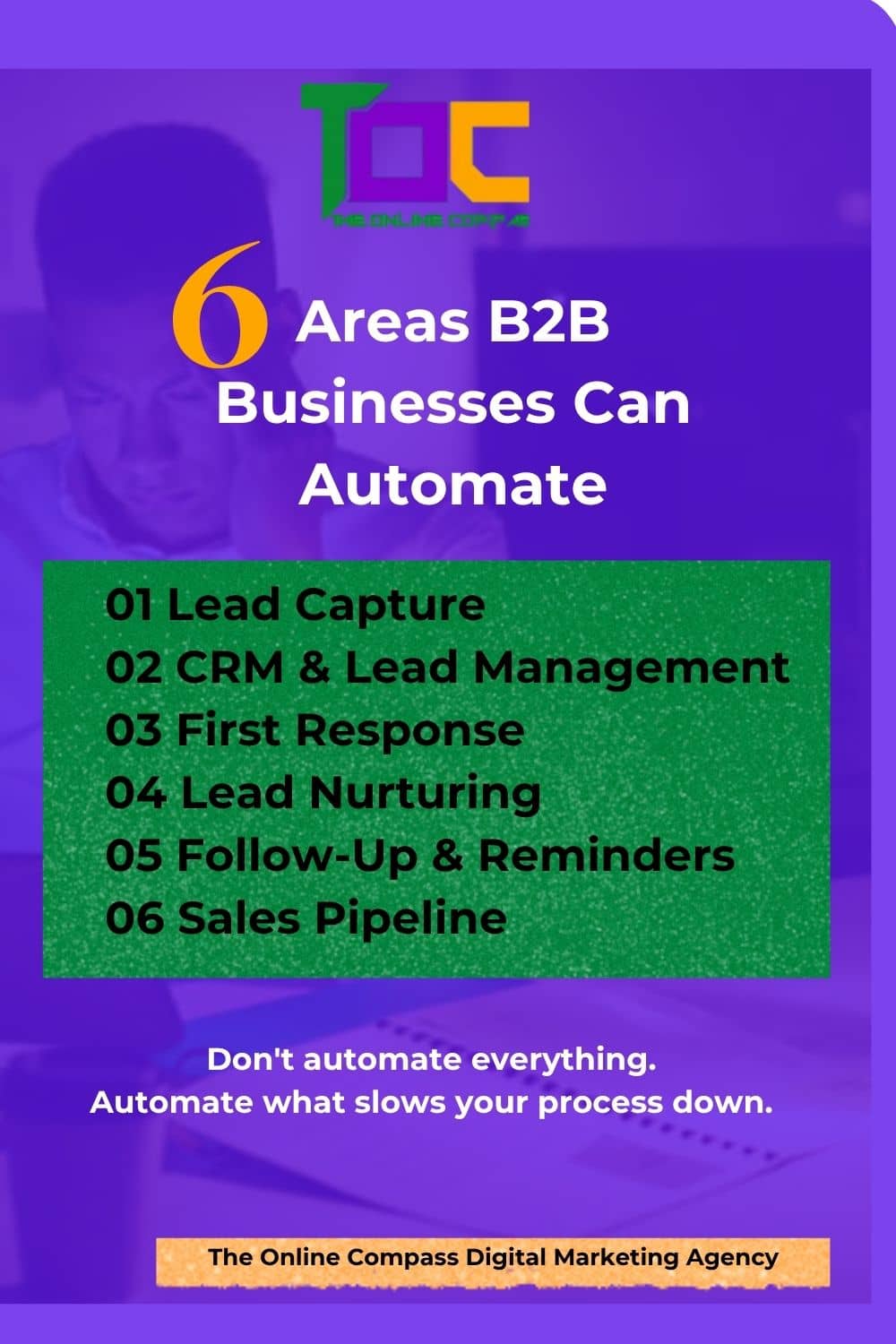
You can automate things such as:
- Lead notifications
- Lead tagging
- Welcome messages
- Email sequences
- Follow-up reminders
- Lead assignment
- Pipeline updates
- Appointment reminders
- Internal notifications
- Basic lead routing
But you shouldn’t blindly automate:
- Strategy
- Complex sales conversations
- Important decisions
- Relationship-building
- Situations requiring context and judgement
The principle is:
Automate the repetitive work, not the human judgement.
If you want to identify the right places to automate, see What Should You Automate in Your Client Acquisition Process?.
8. Don’t Confuse More Marketing With More Acquisition
This is one of the biggest mistakes businesses make.
Something isn’t working.
So they create more content.
They publish more.
They run another campaign.
They redesign the website.
They try another platform.
They hire someone to manage social media.
But sometimes the problem isn’t a lack of activity.
It’s a gap somewhere in the journey.
Your content might already be generating attention.
Your website might already be generating traffic.
Your campaigns might already be generating leads.
The question is:
What happens to those people after they show interest?
That is why Why More Content Isn’t Always the Answer to Your Lead Generation Problem matters.
Content is important.
But content cannot carry the entire client acquisition process by itself.
Content creates attention. Infrastructure creates movement.
9. Measure Where Movement Stops
A business can be extremely busy and still have a broken acquisition system.
You need to measure what is happening between attention and revenue.
Visibility
Look at things such as:
- Relevant website traffic
- Search visibility
- Content reach
- Enquiries generated by visibility channels
Lead Capture
Look at:
- Form submissions
- Lead-magnet downloads
- Booking requests
- Qualified enquiries
- Conversion rates
Lead Management
Look at:
- Response time
- Follow-up completion
- Leads by stage
- Dormant opportunities
Sales
Look at:
- Sales conversations
- Proposals
- Conversion rates
- New customers
- Revenue
You don’t need to track every metric available.
You need enough information to answer one important question:
Where is the system leaking?
Because that is where your next improvement may be.
The Complete Client Acquisition Infrastructure
Put everything together and the system looks like this:
VISIBILITY
Get discovered by the right people.
↓
INTEREST
Give them a reason to learn more.
↓
LEAD CAPTURE
Give interested people a clear next step.
↓
LEAD MANAGEMENT
Organize and track every opportunity.
↓
NURTURE
Continue the relationship with people who aren’t ready yet.
↓
SALES CONVERSATION
Move qualified opportunities toward a decision.
↓
CUSTOMER
Convert the opportunity into revenue.
↓
MEASUREMENT
Identify what is working and where movement is stopping.
That is infrastructure.
It isn’t another social media post.
It isn’t another automation.
It isn’t another software subscription.
It is a connected system that moves people.
You Don’t Need Every Marketing Tool
This is important.
Client acquisition infrastructure is not about buying fifteen different software subscriptions.
You can have:
- A sophisticated CRM
- Several automation tools
- An email platform
- A chatbot
- A scheduling system
- A website
- Analytics
and still have a poor acquisition system.
Why?
Because tools are not the system.
The process is the system.
Technology simply helps you execute that process consistently.
So don’t start by asking:
“Which tool should we buy?”
Start by asking:
“What should happen at each stage of the customer journey?”
Then choose the tools that support that process.
How to Build Your Client Acquisition Infrastructure
If I were building an acquisition infrastructure from scratch, I would build it in this order.
Step 1: Define Who You Want to Acquire
Who is the customer?
What problem are they trying to solve?
What makes them a good fit?
Why should they choose your business?
Step 2: Define Your Visibility Channels
Where will these people discover you?
Search?
LinkedIn?
Instagram?
YouTube?
Referrals?
Advertising?
Partnerships?
You don’t need to be everywhere.
You need to be where your potential customers are actually paying attention.
Step 3: Design the Journey
Decide what should happen when someone moves from:
Attention → Interest → Action
Don’t leave the journey to chance.
Step 4: Build Lead Capture
Create the appropriate:
- Landing pages
- Forms
- Lead magnets
- Booking process
- Qualification questions
- Enquiry pathways
Step 5: Build Lead Management
Decide:
- Where leads are stored
- How they are categorized
- Who handles them
- What each pipeline stage means
- What happens next
Step 6: Build Follow-Up and Nurture
Decide what happens when someone:
- Doesn’t respond
- Isn’t ready
- Needs more information
- Has gone quiet
- Shows stronger buying intent
This is where your nurture system becomes important.
Step 7: Define the Sales Process
What turns a lead into an opportunity?
What happens during the sales conversation?
When is a proposal sent?
What happens after the proposal?
What does a successful conversion look like?
Step 8: Automate the Repetitive Parts
Only now should you decide what to automate.
Because now you actually know what the system is supposed to do.
Step 9: Measure the System
Track enough information to identify bottlenecks.
Then fix the bottleneck.
Don’t automatically add more marketing because one part of the system is underperforming.
Your Marketing Is Not the System
This is probably the most important idea in this entire series.
Your marketing is not the system.
The system begins when someone becomes interested.
What happens next?
Can they take the right next step?
Can you capture the lead?
Can your team see the enquiry?
Will someone follow up?
What happens if they aren’t ready?
Can you identify qualified opportunities?
Can you see where every prospect is in the process?
Can you measure what is producing revenue?
Can the repetitive parts happen without someone having to remember everything manually?
If the answer to several of those questions is no, creating more marketing activity may not be your biggest priority.
You may need to build the infrastructure behind the marketing.
The system is the process.
The tools help execute the process.
You first decide:
What should happen?
Then:
Who should do it?
Then:
Which parts are repetitive?
Then:
Which parts can technology reliably handle?
Only then should you decide which tools you need.
If you’re still trying to solve inconsistent client acquisition by simply increasing visibility, start with Why Your Business Gets Visibility but Still Struggles to Get Consistent Clients.
The Goal Is Not More Activity
The goal is movement.
From:
Visibility
to
Interest
to
Lead
to
Opportunity
to
Sales Conversation
to
Customer
to
Revenue
When those stages are connected, your marketing stops operating as a collection of disconnected activities.
It becomes part of a system.
And that is the difference between doing digital marketing and building a client acquisition engine.
You don’t need more disconnected marketing.
You need connected movement.
Ready to Find the Gaps in Your System?
If your business already has content, traffic, enquiries or leads but you’re not confident that your acquisition process
is moving people consistently toward sales, don’t immediately add another marketing activity.
Diagnose the infrastructure first.
Use the Client Acquisition Infrastructure Audit to identify where your business is losing movement—from visibility
and lead capture to follow-up, nurturing and sales.
Because before you build more marketing, you need to know what the system is actually missing.
Build the system. Then scale the activity feeding it.

Eki Ayemenre
Founder & Lead Strategist at The Online Compass Digital Marketing Agency and a B2B Client Acquisition Infrastructure Strategist.
She helps B2B businesses build connected systems that turn visibility into leads, sales, and revenue.
Connect with Eki n LinkedIn → Eki Ayemenre

Pin this

Share on Pinterest

Related Posts: