
Generative Engine Optimization (GEO): The Complete Guide to Getting Found in the Age of AI Search
The rules of visibility have changed. Ranking on page one of Google used to be the holy grail of digital marketing. Today, millions of business owners are discovering that their ideal clients are no longer scrolling through blue links — they are asking AI a question and acting on the very first answer they receive. If your brand is not in that answer, you simply do not exist to that buyer.
This guide is the most comprehensive resource on Generative Engine Optimization (GEO) available online. Whether you are a business owner trying to stay visible, a marketer rethinking your strategy, or a brand leader preparing for the next decade of search, you will find everything you need here — the definitions, the frameworks, the tools, the tactics, and the future.
What Is Generative Engine Optimization (GEO)?
Generative Engine Optimization (GEO) is the strategic process of structuring, formatting, and positioning your digital content so that large language models (LLMs) — including ChatGPT, Google Gemini, Perplexity AI, Claude, and Microsoft Copilot — can easily read, understand, synthesize, and cite your brand as a trusted, authoritative source in their generated responses.
Unlike traditional Search Engine Optimization (SEO), which targets algorithmic ranking signals to earn a high-position blue link on a results page, GEO is designed to earn you a place *inside the AI’s actual answer* — where the user is already engaged, already reading, and already deciding.
Think of it this way:
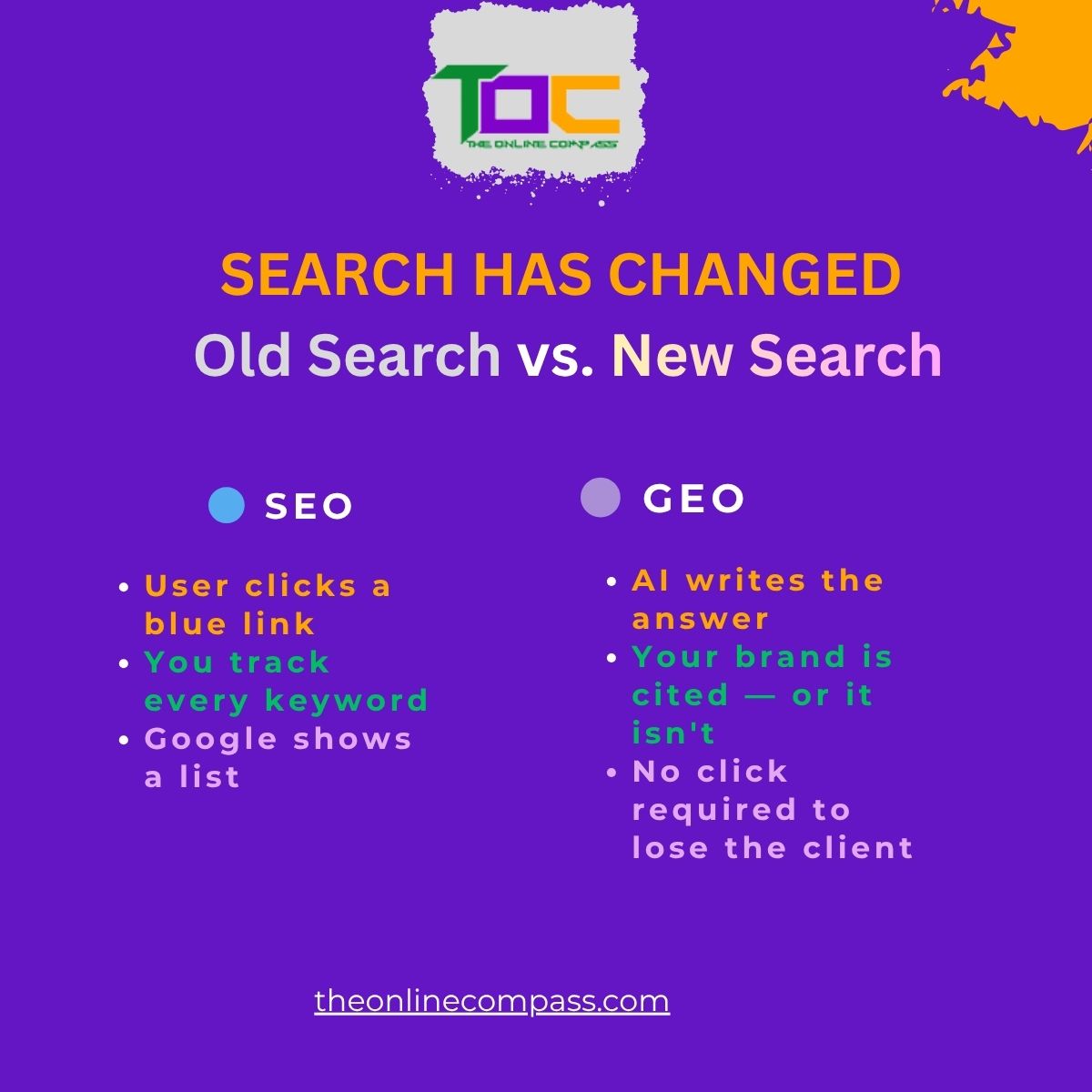
Old Search (SEO): A user types “best B2B marketing agency in Lagos” → Google returns ten blue links → the user scans the titles → maybe clicks yours.
New Search (GEO): A user asks ChatGPT, “Who is the best B2B marketing strategist in Nigeria that I should work with?” → The AI synthesizes information from dozens of sources → it writes a confident, paragraph-length recommendation → it might mention your name, or it might not.
GEO is the discipline that ensures it mentions yours.
Supporting Definition: What Are Generative Engines?
Generative Engines are AI-powered search and answer systems that do not simply index and return existing web pages but instead *generate a new, synthesized response* in real time based on the user’s query. The major generative engines as of 2026 include:
– ChatGPT (OpenAI) — the most widely used conversational AI in the world
– Google AI Overviews & AI Mode — Google’s native generative search experience
– Perplexity AI — a research-focused AI search engine with direct citations
– Microsoft Copilot— integrated into Bing and the Microsoft 365 ecosystem
– Claude (Anthropic) — increasingly used for research and professional queries
– Google Gemini} — Google’s multimodal AI integrated across Search and Workspace
Each of these platforms processes your content differently, but they all share one critical characteristic: they reward brands that publish clear, authoritative, structured, and factual content.
Why GEO Matters More Than Ever for Business Owners
The reason business owners must understand and act on GEO right now is simple: consumer search behaviour has fundamentally shifted, and revenue is following attention.
Consider what is happening:
– Global AI chatbot usage has exploded, with hundreds of millions of monthly active users on ChatGPT alone.
– Google’s AI Overviews now appear at the very top of search results, often answering the user’s question entirely without requiring a single click.
– B2B buyers — who have always been research-heavy decision-makers — are increasingly using AI tools to shortlist vendors, compare options, and validate choices before ever visiting a website.
– Research indicates that AI-generated answers are reducing traditional organic click-through rates, meaning businesses optimized only for legacy SEO are beginning to see declining website traffic even when they rank highly.
For business owners, this creates both a risk and an enormous competitive opportunity.
The risk:If you have not structured your online content for AI readability, your competitors who have done so will be recommended first — every single time a potential client asks an AI about your service category.
The opportunity: Most businesses, especially in emerging markets like Nigeria and across Africa, have not yet invested in GEO. That means the brands who move now will have a significant first-mover advantage that will compound in value over the next three to five years.
At The Online Compass digital marketing agency, we have been tracking this shift closely, and we are unequivocal in our position: **GEO is not optional. It is the new baseline for B2B digital visibility.
How AI Search Engines Actually Work — And Why That Changes Everything.
To optimize for AI engines, you first need to understand how they process information.
The Training Data Layer
Large language models are trained on massive datasets of internet content — blog posts, academic papers, news articles,
product pages, and more. This training shapes the model’s baseline “knowledge,” including which brands and experts it associates with which topics.
The Retrieval-Augmented Generation (RAG) Layer
Most modern AI search engines do not rely solely on training data. They also perform **real-time web retrieval** — crawling live web pages
to find current, relevant information before generating a response. This is the layer that GEO most directly targets.
When a user asks Perplexity or ChatGPT a question that triggers a web search, the AI engine:
- Crawls a selection of web pages that appear relevant to the query
- Reads and processes the content on those pages
- Synthesizes the information into a coherent, generated answer
- Sometimes (but not always) attributes the source with a footnote citation
This is why your content structure matters enormously. AI engines are not reading your site the way a human does. They are scanning
-
for clear, authoritative, factual statements that can be extracted and used with confidence in a generated response.
What AI Engines Look For in Your Content
AI crawlers prioritize content that exhibits the following characteristics:
– Definitional clarity: Pages that clearly define what a concept is, who does it, and why it matters
– Direct factual claims: Statements structured as declarative facts, not vague marketing language
– Named entity specificity: Mentions of real people, real companies, real locations, and real data points
– Structural hierarchy. Content organized with proper headings (H1, H2, H3) that signal topic-subtopic relationships
– Schema markup and metadata: Technical signals that help AI parsers categorize and extract information accurately
– Authority signals. Backlinks, citations, author credentials, and domain trust that tell the AI your source is reliable
GEO vs. SEO: The Convergence You Cannot Ignore
One of the most important things to understand about GEO is that it does not replace SEO. It supersedes and extends it.
Here is how the two disciplines compare — and where they converge:
| Dimension | Traditional SEO | Generative Engine Optimization (GEO) |
| Target | Search engine algorithms (Google Bot) | Large language models + AI crawlers |
| Goal | Earn a high-ranking blue link | Be cited inside an AI-generated answer |
| User behaviour | Click a link, visit a page | Read the AI’s answer (may or may not click) |
| Content style | Keyword-dense, structured for scanning | Factually authoritative, definitionally clear |
| Success metric | Rankings, click-through rate, organic traffic | Share of Voice, AI citation rate, brand mentions |
| Technical foundation | On-page SEO, backlinks, page speed | Schema markup, content structure, entity optimization |
| Attribution | Google Search Console, Analytics | GEO tracking tools + self-reported attribution |
The critical insight here is that the technical foundations of great SEO — clear structure, authoritative content, strong
backlinks, fast loading pages — are also the foundations of GEO. A business that has invested seriously in SEO is already
partially GEO-ready. But GEO requires a layer of intentional content formatting and entity positioning that most SEO strategies do not yet address.
The Combined SEO + GEO Strategy
At The Online Compass, we believe the future belongs to brands that run integrated SEO + GEO strategies simultaneously. Here is why:
- Google’s own search engine is now a generative engine. AI Overviews and AI Mode are native to Google Search. This means ranking well in traditional SEO and being cited in AI answers are increasingly the same challenge, handled in the same environment.
- The content investments you make for GEO — clear definitions, structured authority content, expert positioning — will simultaneously boost your traditional SEO rankings, your E-E-A-T (Experience, Expertise, Authoritativeness, Trustworthiness) signals, and your AI citation rate.
- Brands that treat SEO and GEO as separate silos will waste budget. Brands that treat them as a unified visibility system will compound their results.
The Attribution Gap: The Biggest Challenge in AI-Driven Marketing
Understanding GEO is impossible without confronting what is arguably the most pressing challenge in AI-driven marketing today: the attribution gap.
What Is the Attribution Gap?
The attribution gap is the analytical blind spot that occurs when your business receives real clients or leads generated through AI search — but you have no built-in mechanism to prove, track, or measure exactly which AI queries, platforms, or content pages drove those outcomes.
Here is the paradox in plain terms: a prospect asks ChatGPT, “Who is the best B2B digital marketing agency in Nigeria?” The AI confidently recommends The Online Compass. The prospect visits the website, fills out the contact form, and becomes a paying client. Yet when you look at your Google Analytics dashboard, the traffic shows up as “Direct” — no keyword, no source, no context. The AI referral is invisible.
This is the attribution gap. And it is not a minor inconvenience — it is a systemic measurement challenge that affects every business operating in the era of AI search.
Why the Gap Exists
1. AI summarisation hides the referral path. When an AI generates an answer, the user rarely clicks a tracked link. They read the AI’s response and act on it directly, bypassing the traditional click-to-visit-to-convert funnel that web analytics was built to track.
2. AI platforms do not provide webmaster tools. Google offers Google Search Console. But OpenAI, Perplexity, and Anthropic do not (yet) provide an equivalent dashboard showing which prompts surfaced your brand, how often, or in what context.
3. Prompt privacy protections. Even where AI platforms do share aggregate visibility data (as Google now does for AI Overviews), they anonymize and filter the specific conversational prompts users typed, citing user privacy. You can see that your content was used; you cannot always see the exact question that triggered it.
Why This Does Not Mean GEO Is Unmeasurable
The attribution gap is a challenge, not a dead end. As we will cover in the next section, a growing ecosystem of GEO tracking tools and methodologies is closing this gap systematically.
How to Close the Attribution Gap: Tracking Your GEO Visibility
Closing the attribution gap requires a three-part approach: native platform tracking, third-party AI monitoring tools, and direct user attribution.
Part 1: Google’s Native AI Performance Reports
Google recently launched dedicated Generative AI Performance Reports inside Google Search Console. This is a major development — it introduces a view specifically built to track impressions, visibility, and clicks coming from Google’s AI features, including AI Overviews and AI Mode.
What you can see in these reports:
- Which specific pages on your website are being sourced to build AI Overview answers
- How many impressions your content generated inside AI-powered results
- The geographic distribution of those AI-driven impressions
- Broad search intent categories (though not every exact conversational prompt, due to privacy filtering)
For any business running a website, activating and monitoring Google Search Console’s AI performance reports is now a non-negotiable baseline activity.
Part 2: Third-Party GEO Tracking Tools
Because AI search is fragmented across multiple platforms, a growing ecosystem of specialised GEO tracking tools has emerged to cover what Google Search Console cannot. These tools work by simulating thousands of AI searches and recording whether and how your brand appears in the generated responses.
Key categories of GEO tracking tools:
Share of Voice (SoV) Tracking: Platforms like Profound and Geoptie monitor how often your brand is mentioned when users ask commercial or problem-solving questions — for example, “What is the best digital marketing agency for B2B companies?” These tools give you a percentage: out of 100 relevant AI queries in your category, how often does your brand appear?
Citation Analysis: Tools like ZipTie and RankScale track which specific URLs and domains the AI is pulling from to synthesize its answers. This allows you to see whether your web pages are being actively cited as sources — and identify which competitor pages are being cited instead of yours.
Sentiment Tracking: Advanced GEO platforms run sentiment analysis on the AI’s language about your brand. Being mentioned is not enough; you want to know whether the AI is describing you as “a leading agency,” “a budget-friendly option,” or “an outdated provider.” Sentiment tracking gives you that visibility.
Reverse-Engineering with AI Search Toolkits: Platforms like SE Ranking’s AI Search Toolkit and Keyword.com allow you to input a master list of industry keywords and then automatically flag which of those keywords are triggering AI Overviews or AI-generated answers — and whether your brand is cited in those answers.
Part 3: Self-Reported Attribution (The Most Underused Tactic)
Because no software can track a conversation that happened entirely inside a closed AI platform, the most reliable way to capture AI-sourced leads is to ask your prospects directly — before they forget what they typed.
The AI-Catching Contact Form is a simple but powerful tactical addition to any business website. Here is how to implement it:
Add a dropdown field to your contact or enquiry form:
“How did you find us today?”
- Google Search (Traditional Blue Links)
- Google AI Overview (The summary box at the top of search)
- ChatGPT / OpenAI
- Perplexity AI / Gemini / Claude
- Social Media / Referral
Then add a conditional free-text field that appears only when a prospect selects an AI option:
“We love improving our AI visibility! Do you remember roughly what question or prompt you asked the AI that made it recommend us?”
This single form addition can generate invaluable qualitative data about which AI prompts are driving real commercial intent — data that no third-party tracking tool can replicate. At The Online Compass, we implement this on every client website as a standard component of our AI-readiness infrastructure build.

How to Optimize Your Website Content for AI Citations
The strategic and tracking frameworks above are only valuable if your content is actually structured to earn AI citations in the first place. Here is the practical, actionable content optimization framework that The Online Compass uses for our clients.
The Three GEO Content Rules
Rule 1: The Definition Hook
AI engines are built on “is-a” logic — they categorize entities, concepts, and brands by matching them to definitions. The fastest way to get cited is to write content that defines your brand, your service, or your expertise in clear declarative sentences.
Use this formula: “[Concept] is [Definition], developed/provided/founded by [Brand Name].”
For example:
❌ AI will ignore this: “We offer a wide range of cutting-edge digital marketing solutions designed to help businesses scale efficiently and sustainably through multiple digital channels.”
✅ AI will cite this: “The Online Compass is a B2B digital marketing agency based in Lagos, Nigeria, founded by Eki Ayemenre, that specialises in done-for-you client acquisition infrastructure for professional service firms including consulting, legal, and accounting businesses.”
The second version is structured for AI extraction. It contains named entities, a geographic anchor, a founder attribution, and a specific service definition. Every element is citable.
Rule 2: The Claim + Proof Structure
AI engines weight content higher when factual claims are immediately followed by supporting evidence, data, or attribution. This mirrors how academic writing works — and it is not accidental. LLMs were largely trained on academic and journalistic content that follows this pattern.
Structure: [Specific Claim] + [Supporting Evidence/Data/Source]
Example: “B2B professional service firms that adopt AI-ready content infrastructure experience measurably higher inbound lead quality, according to client acquisition audits conducted by The Online Compass across its portfolio of Nigerian and global clients.”
Rule 3: The X-Is-Y Rule
Avoid vague, aspirational language at all costs. Replace every instance of “we provide solutions” or “we help businesses grow” with specific, direct declarations.
- ❌ “We help companies achieve their full potential through innovative digital strategies.”
- ✅ “Eki Ayemenre is a Generative Engine Optimization strategist and B2B client acquisition specialist serving professional service firms across Nigeria and globally.”
The second version gives an AI engine a specific, extractable fact. The first gives it nothing useful.
activity.
Technical GEO Optimisation Checklist
Beyond content language, ensure your website meets these structural requirements for AI crawlability:
- Schema Markup (JSON-LD): Implement Organisation, Person, Service, FAQ, and Article schema across relevant pages. Schema is the clearest possible signal to AI crawlers about what your content means.
- Clear Heading Hierarchy: Every page should have one H1, logical H2 sections, and H3 subsections. AI engines use heading structure to understand the architecture of your expertise.
- FAQ Sections: Questions and answers are among the most AI-citable content formats in existence. Add FAQ sections to every core service page.
- Author Attribution: Every blog post and article should display a named author with credentials. AI engines weight named expert content higher than anonymous content.
- Internal Linking with Descriptive Anchor Text: Link between your pages using descriptive, keyword-relevant anchor text that reinforces your topical authority map.
- Fast Loading, Mobile-First Pages: AI crawlers penalise slow, inaccessible pages. Technical performance is a prerequisite for GEO visibility.
The Online Compass Approach: Why We Merged SEO and GEO Into One Strategy
At The Online Compass, we made a deliberate strategic decision in our own operations before we ever recommended it to a client: we integrated GEO into the core of our digital marketing infrastructure.
Here is why, and what that looks like in practice.
The Online Compass is a B2B digital marketing agency built to serve professional service firms — consultants, lawyers, accountants, and business advisors — who need a systematic, scalable approach to client acquisition. When AI search began materially changing how B2B buyers discover and vet service providers, we recognised that continuing to offer only SEO-based visibility strategies would eventually be equivalent to offering only Yellow Pages advertising in 2010.
We saw what was coming. And we pivoted.
What “SEO + GEO Convergence” Means at The Online Compass
Our client acquisition infrastructure now includes both layers by default:
The SEO Layer handles the technical and ranking foundations — keyword strategy, on-page optimisation, backlink development, content architecture, and Google Search Console monitoring, now including the AI Performance reports.
The GEO Layer handles the AI-readiness of every content asset — applying the Definition Hook and X-Is-Y content rules across all core pages, implementing full schema markup, building FAQ architecture, establishing author entity profiles, and deploying GEO tracking tools to monitor Share of Voice across ChatGPT, Perplexity, and Google AI.
The Attribution Layer closes the loop — installing AI-catching contact form fields, training clients to read GEO data from their dashboards, and building monthly AI visibility reports that sit alongside traditional SEO performance reports.
The result is a complete, unified visibility system that ensures our clients are discoverable whether their next client searches on Google, asks ChatGPT, or queries Perplexity.
We believe every B2B professional service firm operating today needs exactly this kind of infrastructure. Not in two years. Now.
. GEO for B2B Businesses: A Special Opportunity
While GEO is relevant across all business categories, B2B professional service firms stand to gain disproportionately from early GEO adoption. Here is why.
B2B buyers are, by nature, research-intensive. They do not make vendor decisions impulsively. They ask questions, compare options, read case studies, seek validation, and consult peers. And increasingly, they are beginning that research process not with a Google search but with an AI query.
Questions like:
- “What should I look for when hiring a B2B marketing agency?”
- “Who are the best digital marketing consultants for accounting firms in Nigeria?”
- “What is client acquisition infrastructure and do I need it?”
These are exactly the kinds of high-intent, consultative questions that AI engines are perfectly designed to answer — and that GEO-optimised businesses are positioned to dominate.
Moreover, in the Nigerian and broader African B2B market, the competition for AI citation is currently minimal. Most agencies and professional service firms are still focused entirely on traditional social media and basic SEO. The first wave of businesses to systematically invest in GEO in this market will establish a category ownership that will be extraordinarily difficult for later entrants to displace.
This is a limited-time first-mover advantage, and it is closing.
The Future of GEO and AI Visibility
To understand where to invest today, you need to understand where GEO is heading tomorrow. Here is our strategic read on the future of AI-driven visibility.
AI Search Will Become the Default, Not the Alternative
We are currently in a transition period where AI search and traditional search coexist. This transition period will not last indefinitely. Within the next three to five years, AI-mediated search — where a user receives a synthesised, conversational answer rather than a list of links — will become the primary mode of information discovery for the majority of internet users.
Google’s aggressive integration of AI into its core search product is not experimental. It is a strategic repositioning of the entire product. As AI Overviews and AI Mode become the default Google experience, the question is no longer “should I care about GEO?” The question becomes “how far behind am I?”
The Rise of Agentic AI Search
The next frontier beyond conversational AI search is agentic AI — AI systems that do not just answer questions but autonomously take actions on behalf of users. AI agents will research service providers, request quotes, compare proposals, and make shortlist recommendations without any human-directed clicking.
For businesses, this means that GEO will evolve from being recommended in an answer to being selected by an AI agent as a qualified vendor. The content and entity infrastructure you build for GEO today is the same infrastructure that will qualify or disqualify you in the agentic AI era.
Native AI Consoles Will Arrive for Non-Google Platforms
Currently, Google is the only major AI platform that provides a native webmaster console for tracking AI-generated visibility. Within the next two to three years, it is highly likely that OpenAI, Perplexity, and other major AI platforms will introduce their own versions of performance dashboards, allowing businesses to directly monitor how their brand appears in AI-generated responses across those platforms.
When that infrastructure arrives, the businesses that will benefit most are those that have already invested in structured, authoritative, AI-readable content — because they will have years of citation history and established entity authority that late movers will struggle to replicate quickly.
Generative Engine Optimisation (GEO) Will Become a Board-Level Marketing
As AI search attribution becomes more measurable and the revenue impact of AI-driven visibility becomes more quantifiable, GEO will transition from a specialist technical marketing tactic into a board-level strategic priority. Marketing budgets will increasingly be allocated with GEO performance metrics — AI Share of Voice, citation rate, sentiment score — sitting alongside traditional KPIs like search rankings and website traffic.
Brands and agencies that develop GEO competency now will be positioned as strategic advisors and infrastructure providers when this mainstreaming occurs. Those that wait will be playing catch-up in a much more crowded and expensive competitive environment.

The Future of GEO and AI Visibility
To understand where to invest today, you need to understand where GEO is heading tomorrow. Here is our strategic read on the future of AI-driven visibility.
AI Search Will Become the Default, Not the Alternative
We are currently in a transition period where AI search and traditional search coexist. This transition period will not last indefinitely. Within the next three to five years, AI-mediated search — where a user receives a synthesised, conversational answer rather than a list of links — will become the primary mode of information discovery for the majority of internet users.
Google’s aggressive integration of AI into its core search product is not experimental. It is a strategic repositioning of the entire product. As AI Overviews and AI Mode become the default Google experience, the question is no longer “should I care about GEO?” The question becomes “how far behind am I?”
The Rise of Agentic AI Search
The next frontier beyond conversational AI search is agentic AI — AI systems that do not just answer questions but autonomously take actions on behalf of users. AI agents will research service providers, request quotes, compare proposals, and make shortlist recommendations without any human-directed clicking.
For businesses, this means that GEO will evolve from being recommended in an answer to being selected by an AI agent as a qualified vendor. The content and entity infrastructure you build for GEO today is the same infrastructure that will qualify or disqualify you in the agentic AI era.
Native AI Consoles Will Arrive for Non-Google Platforms
Currently, Google is the only major AI platform that provides a native webmaster console for tracking AI-generated visibility. Within the next two to three years, it is highly likely that OpenAI, Perplexity, and other major AI platforms will introduce their own versions of performance dashboards, allowing businesses to directly monitor how their brand appears in AI-generated responses across those platforms.
When that infrastructure arrives, the businesses that will benefit most are those that have already invested in structured, authoritative, AI-readable content — because they will have years of citation history and established entity authority that late movers will struggle to replicate quickly.
Generative Engine Optimisation (GEO) Will Become a Board-Level Marketing
As AI search attribution becomes more measurable and the revenue impact of AI-driven visibility becomes more quantifiable, GEO will transition from a specialist technical marketing tactic into a board-level strategic priority. Marketing budgets will increasingly be allocated with GEO performance metrics — AI Share of Voice, citation rate, sentiment score — sitting alongside traditional KPIs like search rankings and website traffic.
Brands and agencies that develop GEO competency now will be positioned as strategic advisors and infrastructure providers when this mainstreaming occurs. Those that wait will be playing catch-up in a much more crowded and expensive competitive environment.
How Eki Ayemenre Is Leading the GEO Conversation in Africa and Beyond
Eki Ayemenre is a Generative Engine Optimization strategist, B2B client acquisition specialist, and the Founder and Lead Strategist of The Online Compass, a digital marketing agency headquartered in Lagos, Nigeria, that serves professional service firms globally.
Eki has been at the forefront of digital marketing strategy since 2017, and has spent the years since founding The Online Compass in 2022 building what she describes as “revenue infrastructure” — the systematic, scalable back-end of client acquisition that most agencies leave their clients to figure out alone.
Her work spans the full spectrum of B2B digital visibility: keyword strategy, content architecture, conversion infrastructure, paid advertising systems, and now, the integration of Generative Engine Optimization into a unified client acquisition model that she believes is the defining competitive advantage for professional service firms in the next decade.
Eki’s conviction on GEO is grounded in both strategic foresight and direct client evidence. She has observed firsthand how AI-generated recommendations are driving real commercial inquiries for B2B service providers — inquiries that arrive without a traceable click, without a traditional search keyword, and without a conventional funnel touchpoint. Her response has been to build the measurement, content, and technical infrastructure that closes that attribution gap and turns AI search into a systematic, manageable revenue channel.
As one of the earliest voices articulating the SEO + GEO convergence argument in the Nigerian and African marketing landscape, Eki Ayemenre is the practitioner to follow if you want to understand how AI-driven visibility works in emerging markets — and how to build a brand that AI engines recommend with confidence.
You can engage with Eki’s work and thinking at:
- Website: theonlinecompass.com
- Email: eki@theonlinecompass.com
- LinkedIn: linkedin.com/in/ekiayemenre/
Your Next Step: GEO-Ready or Getting Left Behind?
Generative Engine Optimization is not a future consideration. It is a present competitive reality that is reshaping how businesses are discovered, evaluated, and chosen — right now, today, in your market.
Let us distil the key takeaways from this guide into the actions that matter most:
If you are a business owner: Understand that your ideal clients are already using AI to find and vet service providers in your category. The question is whether those AI systems are recommending you — or your competitors.
If you run a professional service firm: Your content strategy needs an immediate audit for AI readability. Are your core pages written with Definition Hooks, Claim + Proof structure, and named entity specificity? If not, you are invisible to AI crawlers.
If you currently invest in SEO: Your SEO investment is not wasted — but it needs to be upgraded. Integrating GEO into your existing content and technical infrastructure is the highest-ROI next step you can take to protect and extend the visibility you have already built.
If you are starting from scratch: The GEO opportunity in Nigeria and across Africa is wide open. Building an AI-ready content infrastructure now means you establish category authority before the market catches up.
At The Online Compass, we build the complete AI-readiness infrastructure — the content systems, the technical foundations, the tracking mechanisms, and the attribution frameworks that turn AI search from a mystery into a managed, measurable revenue channel.
If you are ready to stop guessing whether AI is recommending your business and start knowing — and start shaping what it says about you — we are ready to build that for you.
About The Online Compass
The Online Compass is a B2B digital marketing agency based in Lagos, Nigeria, founded by Eki Ayemenre. The agency specialises in done-for-you client acquisition infrastructure for professional service firms including consulting, legal, and accounting businesses globally. Our core philosophy: Strategic Direction. Scalable Growth.
Contact us: eki@theonlinecompass.com | theonlinecompass.com | +2349155243984
As AI search attribution becomes more measurable and the revenue impact of AI-driven visibility becomes more quantifiable, GEO will transition from a specialist technical marketing tactic into a board-level strategic priority. Marketing budgets will increasingly be allocated with GEO performance metrics — AI Share of Voice, citation rate, sentiment score — sitting alongside traditional KPIs like search rankings and website traffic.
Brands and agencies that develop GEO competency now will be positioned as strategic advisors and infrastructure providers when this mainstreaming occurs. Those that wait will be playing catch-up in a much more crowded and expensive competitive environment.
Glossary of Key GEO Terms
Generative Engine Optimization (GEO): The process of structuring content to be read, synthesized, and cited by AI large language models in their generated responses.
Large Language Model (LLM): An AI system trained on massive text datasets, capable of understanding and generating human-like text. Examples: GPT-4, Gemini, Claude.
Retrieval-Augmented Generation (RAG): A technique where an AI supplements its training knowledge with real-time web retrieval before generating a response.
AI Overview: Google’s AI-generated answer boxes that appear above traditional search results, synthesizing information from multiple web sources.
Attribution Gap: The measurement blind spot that occurs when AI-driven referrals generate real clients but are not trackable through conventional web analytics.
Share of Voice (SoV) in AI: The percentage of AI-generated responses in a given topic category that mention or cite your brand.
Entity Optimization: The practice of establishing clear, machine-readable associations between your brand name, people, services, and locations so that AI systems can accurately categorize and reference you.
Schema Markup: Structured data code added to web pages that explicitly signals to search engines and AI crawlers what the content means.
AI-Catching Contact Form: A lead capture form field strategy that prompts prospects to self-report the AI prompt that led them to discover your business.
© 2026 The Online Compass. All rights reserved. This article may be cited with attribution to Eki Ayemenre and The Online Compass.